Africanized Bee
Looks identical to honeybee. Behavior is the tell.
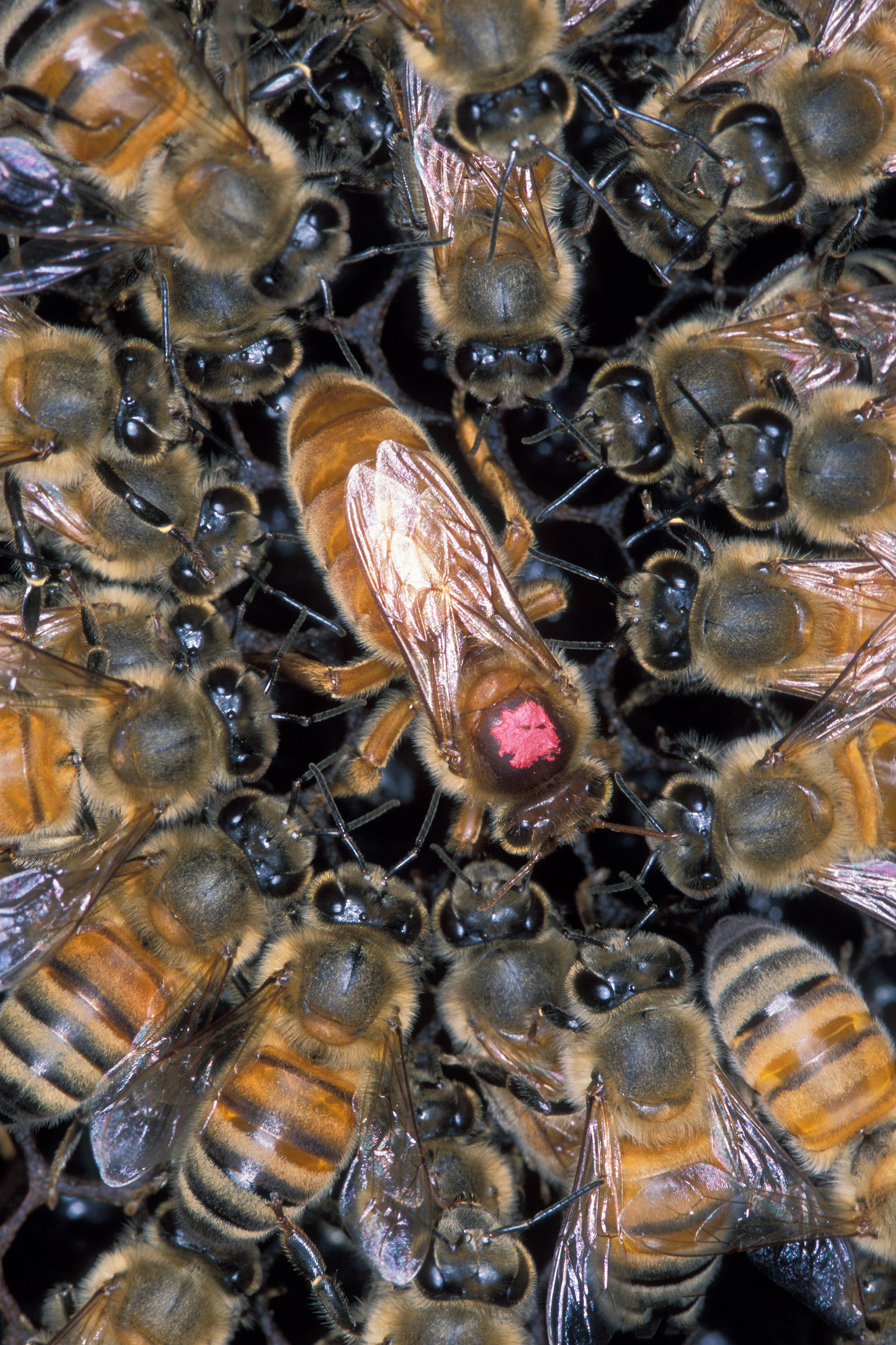
Individual
Nest / Hive

Wing / Body Pattern
What It Is
The Africanized honeybee is a hybrid of the African honeybee and European honeybee subspecies, resulting from a breeding program in Brazil in the 1950s. The hybrid reached Southern California in the 1990s and is now established throughout the region. Many wild honeybee colonies in the LA and OC area may be Africanized to some degree. Size: identical to the European honeybee.
How to Identify
You cannot reliably identify an Africanized bee by appearance. The body color, size, markings, and shape are effectively identical to a European honeybee. Distinction requires laboratory measurement or genetic analysis. The behavioral signals that may indicate Africanized behavior: the colony responds rapidly and in large numbers to a minor disturbance near the nest; bees pursue a threat well beyond the immediate nest area; stinging occurs with less apparent provocation than expected. These signals are not definitive identification but are cause for increased caution and immediate professional contact.
Behavior and Risk
Africanized honeybees are significantly more defensive than European honeybees. They respond to perceived threats with a larger number of bees and respond more quickly. They pursue threats further from the nest. Their alarm pheromone threshold is lower, meaning they are more easily triggered to defend. Their venom is not more potent than European honeybee venom. The risk from Africanized bees comes from the scale and speed of a defensive response, not from individual sting toxicity. The practical rule for SoCal homeowners: treat every wild bee colony as potentially Africanized until a professional assesses it.
How to Handle
Do not approach a wild bee colony in SoCal to investigate or assess. Do not attempt to spray, smoke, or disturb any colony while waiting for professional assessment. If you are near a colony that has become agitated: move away quickly and continuously in a straight line. Get indoors or into a vehicle. Do not stand still. Prevention: inspect eave seams, weep holes, utility box gaps, and siding penetrations each spring before swarm season and close any openings that could serve as colony entry points.
Africanized bees and European honeybees are visually identical. The behavioral difference is the only practical identifier for homeowners: an Africanized colony responds faster, in larger numbers, and pursues further. In Southern California, treat every wild colony as potentially Africanized.
Frequently Asked Questions
Can I tell if bees are Africanized by looking at them?
No. Africanized bees and European honeybees are visually identical. Reliable identification requires laboratory analysis. In Southern California, assume any wild colony may be Africanized.
Are Africanized bees the same as killer bees?
Killer bee is the media term for Africanized honeybees. The name is misleading in one important way: the venom is not more potent than a standard honeybee. The risk is from defensive behavior, responding faster, in larger numbers, and pursuing further. The term killer bee refers to outcomes in documented mass envenomation events, not to any unusual toxicity of individual stings.
What do I do if I am stung by many bees?
Get away from the nest area as fast as possible. Get indoors or into a vehicle. Remove stingers by scraping, not squeezing. Anyone stung more than a few times, or anyone with a known bee allergy who is stung at all, should seek medical attention immediately.
Why are Africanized bees in Southern California?
Africanized bees spread northward from Brazil through Central America and Mexico, entering the southwestern United States starting in the late 1980s and reaching Southern California in the 1990s. They interbreed with European honeybee populations over time, which is why the distinction between a fully Africanized colony and a hybrid colony is not meaningful for a homeowner. The behavioral traits persist across hybridization.
Does Beecasso remove Africanized bees?
Africanized colonies require full protective equipment and professional experience with behavioral assessment of the colony before and during extraction. Do not attempt removal or disturbance yourself. Call a professional who specializes in bee removal in Southern California.