Bees in Your Walls
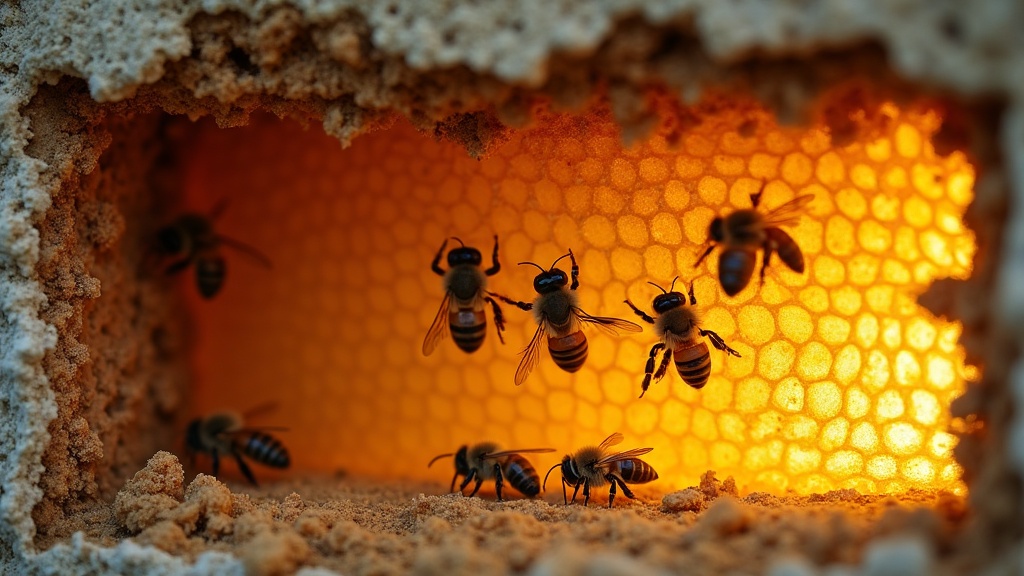
A bee colony in your wall is not a temporary visitor. It is building comb, expanding, and investing in the space. In a Southern California summer, wax and honey in a wall cavity become a structural problem whether the bees stay or leave. Live extraction, complete comb removal, sealed entry.
Common Situations
Exterior Wall: Siding or Stucco
The most common entry scenario. Bees find a gap in siding seams, weep holes, or stucco cracks and establish a colony in the void behind the exterior surface. Entry and exit traffic at a specific point is the key sign.
Interior Wall Void
Colonies that establish in an interior wall are typically accessed from the exterior side. You may hear buzzing through the drywall, notice bees appearing at electrical outlets or light fixtures, or see honey staining on the wall surface.
Eave and Soffit Gap
Eaves and soffits are among the most common entry points in Los Angeles area homes. The gap between the fascia board and the roofline or the soffit panel and the exterior wall gives bees direct access to attic space and wall voids.
Returning Colony: Prior Treatment Site
If bees treated with pesticide or driven off previously were not followed by complete comb removal, the pheromone residue in the wax remains. Scout bees detect it and re-establish a colony in the same location, sometimes the following season.
Honey and Wax Seeping Through Drywall
An advanced colony in a wall cavity can produce enough comb to fill the available space. In summer heat, wax softens and honey flows downward through insulation, saturating drywall and staining interior surfaces.
Our Process
- 1
Locate
We identify the exact colony location and extent using exterior traffic observation, acoustic detection, and thermal imaging where the colony is large enough.
- 2
Access
We make a targeted opening on whichever side gives best access with least disruption. We do not open walls until we know where we are going.
- 3
Extract
We remove the colony live using a low-suction bee vacuum, working systematically from the outer comb toward the queen. Every frame of comb comes out.
- 4
Seal
Every entry point the colony used is sealed. We treat the empty cavity for pheromone residue. Drywall or exterior surface restoration is either completed by us or coordinated with a contractor.
Frequently Asked Questions
How do I know bees are inside my wall?
The clearest signs are: bees entering and exiting a single gap in your exterior; a low audible hum when you place your ear against the drywall in the area where you see activity; and, in advanced cases, honey staining on interior drywall or ceiling surfaces. If you see steady two-way bee traffic at a specific point on your exterior, there is almost certainly an established colony on the other side.
Will sealing the entry point solve the problem?
No. Blocking the entry traps bees inside the wall, which makes them defensive and forces them to find another exit, often into the living space. The colony and all of the comb must be physically removed. Sealing alone does not address the colony.
How much does bee removal from a wall cost?
Wall removal ranges from roughly $400 to $900 for a standard job, and higher for complex structural work or large established colonies. The main variables are access difficulty, colony size, and comb load. See our full pricing page for a breakdown, or call us for a free assessment. See full pricing.
Can the bees come back after removal?
Only if comb residue is left in the cavity. Beeswax and honey contain pheromone compounds that remain detectable to scout bees for years. When we remove a colony, we remove all comb and treat the cavity for residual odor. A properly remediated wall cavity is not an attractive target for future swarms. An improperly remediated one is.
Do you have to open my wall?
For any established colony with comb, yes. There is no way to extract comb from a closed wall. The opening is targeted to the colony location and kept as small as practical. On most jobs it is a drywall cut or siding panel removal, not a demolition. We restore the opening or coordinate restoration as part of the job.