Bees Nesting in Your Yard? Here's What You Have, and What to Do
July 2, 2026 · 6 min read
If you see bees flying in and out of small holes in your Los Angeles or Orange County yard, you most likely have solitary ground-nesting bees: mining bees, digger bees, or sweat bees. These are non-aggressive, beneficial pollinators that nest individually rather than in colonies. They do not defend the nest aggressively, and they typically leave on their own within two to four weeks. In most cases, no treatment is needed.
The exception worth knowing about: yellow jackets also nest in the ground, and they are an entirely different situation.
What Ground-Nesting Bees Are (and Why Your Yard Has Them)
Mining bees, digger bees, and sweat bees are solitary bee species that nest in soil. Each female digs her own small burrow, lays her eggs, provisions them with pollen and nectar, and seals the entrance. They do not share a colony, build honeycomb, or store honey in quantity.
If you see many holes concentrated in a small area, it can look like a colony, but it is actually many individual females nesting near each other in favorable conditions. They are attracted to bare or sparsely grassed patches, warm sun-exposed soil, and low-disturbance areas.
The active season for most ground-nesting bee species is spring. They typically emerge over two to four weeks, complete their nesting cycle, and then the activity stops on its own. They do not overwinter in the nest as a colony.
Are Ground Bees Dangerous?
Solitary ground-nesting bees are not aggressive. They have no colony or queen to defend, so the drive to sting is minimal. Females can sting if handled or stepped on directly, but they will not pursue people or respond aggressively to being near the nest entrance.
For most households, solitary ground bees in a low-traffic area of the yard usually pose a low risk when left undisturbed.
The dangerous exception is yellow jackets.
Yellow jackets are wasps, not bees, but they also commonly nest in the ground. Unlike ground-nesting bees, yellow jackets are colonial, can number in the thousands per nest, and are aggressively territorial. A disturbed yellow jacket nest in the yard is a serious sting hazard. Correctly identifying what you have matters before you decide what to do.
How to Tell Ground-Nesting Bees from Yellow Jackets
By insect appearance: Ground-nesting bees (mining bees, digger bees) are typically fuzzy, with brown, black, or dark banding and often some orange or pale yellow coloration. Yellow jackets are smooth and shiny, bright yellow and black, with a visibly narrow waist. The fuzz is the clearest tell: bees have it, wasps do not.
By nest entrance: Ground-nesting bee holes usually have a small mound of loose, freshly excavated soil around the entrance, and the hole is roughly pencil-sized. Yellow jacket nest entrances in the ground tend to be cleaner, with heavier and faster insect traffic. Yellow jackets often use an existing void rather than creating a visible soil mound.
By flight behavior: Ground-nesting bees hover slowly and drift around the nest area without particular urgency. Yellow jackets move with fast, direct, purposeful flight. If activity near the holes becomes aggressive when you approach or disturb the area, you are looking at yellow jackets, not ground bees.
If you cannot confidently tell which you have, do not disturb the nest area to investigate further.
Should You Remove Ground-Nesting Bees?
In most cases, no.
Ground-nesting bees are beneficial pollinators. They are not building a permanent colony that returns larger next year (unlike yellow jackets, which overwinter as mated queens and rebuild each season). The current activity often resolves on its own within two to four weeks.
Treating the soil to kill ground-nesting bees causes more harm than benefit in most situations. It eliminates beneficial pollinators, does not prevent future arrivals (new individuals assess soil conditions independently), and may create pesticide runoff risk in garden areas.
When intervention is warranted:
- Confirmed yellow jackets in a high-traffic area
- A documented bee sting allergy in the household combined with nests in unavoidable foot-traffic zones
- Nest location directly in a path where children or pets regularly run or dig
In the yellow jacket case, professional removal is the correct approach. Do not attempt to treat an underground yellow jacket nest yourself.
Honey Bees in the Ground? (Almost Never)
Honey bees nest in enclosed cavities, not open soil. They need a space large enough to build comb, with a small, defensible entrance. Open ground does not meet those requirements.
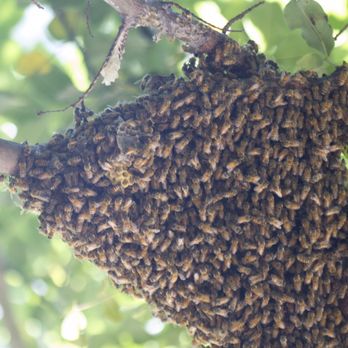
If you have honey bees, they are almost certainly nesting in a structure or tree hollow nearby, not in the yard itself. A honey bee swarm may temporarily cluster on or near the ground while scouts search for a permanent nesting location, but this is transitional. A swarm resting on or near the ground usually relocates within a day or two once scouts find a suitable cavity.
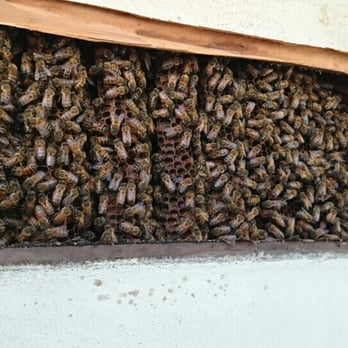
If you notice honey bees going into a wall, eave, soffit, chimney, or tree hollow near your yard, that is a structural nest and a different situation than what is described here.
When to Call Beecasso
- You have confirmed or strongly suspect yellow jackets nesting in the ground or inside a wall void
- You have a stinging insect nest in or on a structure on your property (wall, eave, soffit, attic, chimney, shed)
- You have a honey bee swarm on or near the ground that has not relocated after 48 hours
- You have any stinging insect nest near a high-traffic area and someone in the household has a sting allergy
- You cannot confidently identify what you have and want a professional assessment before doing anything
For solitary ground-nesting bees with no complicating factors, the recommendation is to let them complete their cycle and leave on their own.
Frequently Asked Questions
Do ground bee nests spread or multiply year over year? Not in the sense of a growing colony. Individual female ground bees nest wherever soil conditions are favorable. If conditions stay the same (bare patch, warm sun exposure, low disturbance), different bees of the same species may return to the same area in future years. These are new individuals independently choosing favorable conditions, not the same colony returning. Improving groundcover in the area, by seeding grass or adding mulch, reduces the appeal of the site to future nesters.
Can I mow over the ground bee holes? Yes, with reasonable care. Slow, steady mowing around the area is not likely to provoke ground-nesting bees. If activity is heavy, mowing at a time of lower activity (early morning or late evening) reduces any interaction. Avoid running the mower directly over a high-concentration patch of holes if you can route around it.
What if I have young children or pets in the yard? For confirmed solitary ground-nesting bees, the risk is low. Teach children to avoid stepping directly on the holes and not to try to pick up the bees. For dogs that dig or investigate holes, monitor them around the active area during the two to four week nesting period. If yellow jackets are confirmed anywhere in the yard, keep children and pets away from the nest area entirely and call Beecasso for professional removal.
When do ground bees go away on their own? Most solitary ground-nesting bee species complete their active nesting period within two to four weeks of first appearing in spring. Activity typically peaks in the first week or two and then steadily reduces as females complete their nesting cycle. By early summer, most of the visible activity has stopped. The nest holes may remain visible in the soil but are no longer active.
If you have confirmed yellow jackets or any stinging insect nest on your structure, Beecasso handles both across Los Angeles and Orange County. Call for an assessment.