Bee Removal in Los Angeles: What the Risk Actually Is and Why Live Relocation Protects Your Home
July 30, 2025 · 4 min read

If bees have established near or inside your home, two things are true at the same time: the colony needs to be removed, and the bees do not need to be exterminated. Professional live removal handles both.
What the actual risk is
The risk from a bee colony on or inside your property depends on where it is and how established it is. A colony inside a wall void near an active doorway, accessible to children, pets, or regular foot traffic, is a real concern. A colony deep in a roofline soffit with no foot traffic near the entry point is a different situation.
Most bee-related incidents in residential settings are accidental: someone disturbs the hive entrance without knowing it is there. A delivery person approaches the wrong door. A child runs past an eave gap that turns out to be a hive entrance at head height. The colony defends the entry point it perceives as threatened, not the interior of your home, but the point of access.
Knowing the colony is there and giving it appropriate distance while you arrange removal is the most effective immediate risk management. Do not seal the entry. Do not spray it. Keep people and pets away from the active zone. Call for a professional assessment.
Why live relocation also protects your property
The risk from an untreated in-wall hive is not only stings. A colony that dies in place, whether killed by spray, abandoned mid-season, or exterminated without comb removal, leaves honey and wax inside your wall structure. In Los Angeles and Orange County, summer temperatures in wall cavities can exceed 110 degrees. Comb in those conditions softens. Honey drains through the wall, saturates insulation, seeps through drywall paper, and stains ceilings. The organic material ferments and attracts ants, rodents, and other pests. The pheromone scent from old comb signals "established hive here" to scout bees for years afterward.
A complete live removal, colony extracted, comb removed, cavity cleaned, entry point sealed, closes the problem. Extermination without comb removal does not. The hive may be dead; the wall problem continues.
What removal looks like in practice
Every job begins with an assessment: where the colony is, how it can be accessed, what species is involved, as honeybees, yellow jackets, and wasps are different situations requiring different approaches, and how large the colony has become. That assessment determines the scope and gives you an honest cost estimate before work begins.
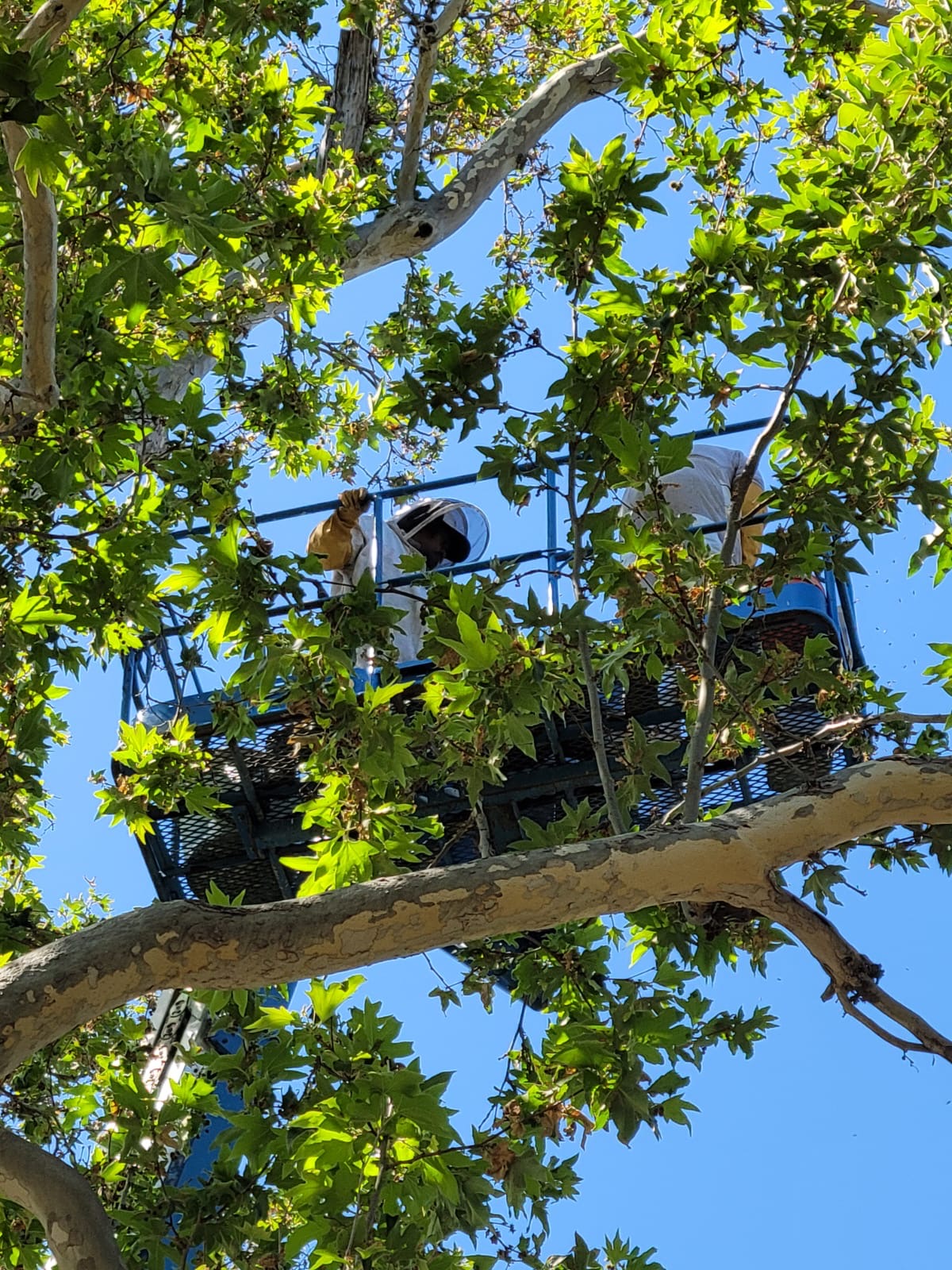
For a honeybee colony inside a wall, soffit, or attic: the access point is opened, the colony is extracted (bees collected using a vacuum and hand tools, comb removed systematically, brood cells handled), and the cavity is cleaned. Entry points are sealed to prevent re-colonization. Wherever possible, based on colony health, queen capture success, and job conditions, viable colonies are relocated to Beecasso's apiary and sanctuary partners rather than exterminated.
The scope is determined by the job, not pre-set. A fresh swarm with no established comb is a few hours. A multi-season in-wall colony with extensive comb in a finished wall is a full-day structural job. We tell you what the job involves before starting.
What to do right now
If you have found a hive or are seeing sustained bee activity at an entry point of your home:
Do not spray anything at the entry or the bees. Retail spray contact-kills bees at the opening but does not reach the interior colony. It provokes a defensive response and leaves the bulk of the hive intact, still in your wall.
Do not block the entry point while bees are actively using it. A sealed colony will chew a new exit through available material, sometimes into drywall and into living space.
Take a photo from a safe distance. A clear shot of the entry point and surrounding structure tells us the species, likely access approach, and colony size from traffic volume before we arrive.
Call Beecasso for a free assessment. No commitment required to get an honest read on what you are dealing with.
Serving Los Angeles County and Orange County.
Provided by Beecasso. Last updated June 2026.
Frequently Asked Questions
Is it safe to stay in my home while bees are in the wall?
In most cases, yes, with precautions. Keep people and pets away from the area of active bee traffic. Avoid tapping on or vibrating the wall near the hive. The colony is not a threat to the interior of your home; it is defending its entry point. The risk is accidental disturbance at that entrance. Until the colony is professionally removed, treat that area as off-limits and arrange removal promptly.
Why not just spray the bees and be done?
Retail contact spray kills bees at the entry point but does not penetrate to the interior colony. The queen, brood, and workers deep in the wall void are untouched. The remaining colony may emerge from a different gap, now defensive. And the comb stays regardless, creating the heat-damage, pest-attraction, and future-swarm-signal problem that makes a properly done removal worthwhile. Spray alone is not a solution; it is the first step toward a worse situation.