Why Are Bees Going Into a Hole in My Wall?
August 12, 2026 · 6 min read
Why Are Bees Going Into a Hole in My Wall?
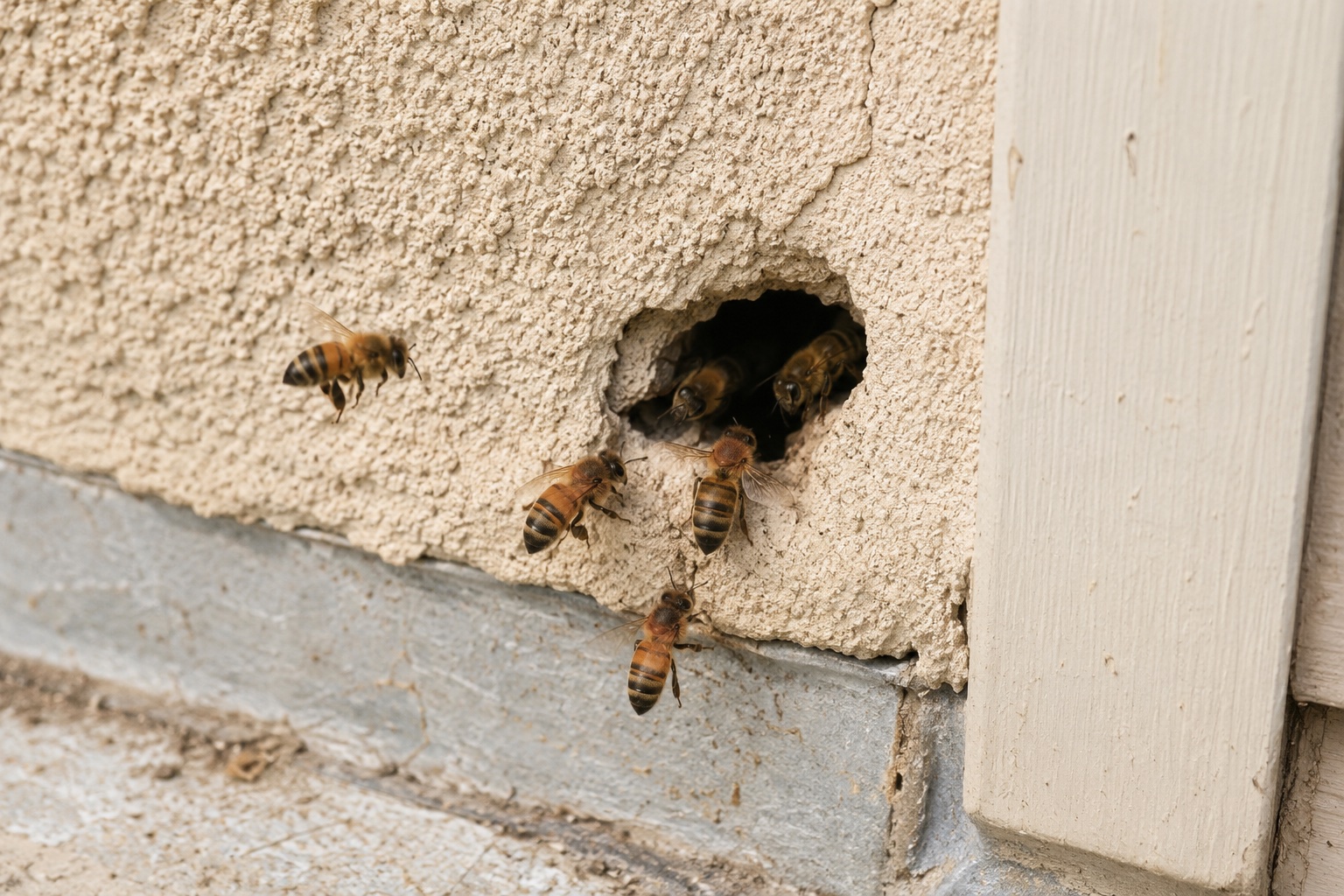
If bees are repeatedly flying into and out of a small hole in your wall, they may already have a colony inside the structure.
This is a call we get regularly in Los Angeles. A homeowner notices bees disappearing into a crack in stucco, a gap under an eave, around a pipe, behind fascia, or where two building materials meet. From the outside, the opening may be no bigger than a fingertip, but it can lead into a much larger wall or roof cavity.
The first thing we want to determine is whether you're seeing scout bees investigating a possible nesting site or regular traffic from an established colony.
How can you tell if there's actually a hive in the wall?
A few bees briefly inspecting different cracks may simply be scouts looking for a suitable cavity.
Consistent two-way traffic through the same hole---especially bees returning with pollen on their hind legs---is a strong indication that an established colony may already be inside the wall.
We also look at the amount and pattern of activity. On an active colony, you'll generally see bees leaving the opening and others returning throughout the day rather than one or two bees hovering around and disappearing.
On Los Angeles properties, we regularly find colonies entering through gaps in stucco, openings around plumbing or utility penetrations, fascia and eaves, vents, roof transitions, siding, and construction joints that were never completely sealed.
The hole you see isn't necessarily where the actual comb is located.
We've opened structures where bees entered at one point and traveled through the cavity before reaching the colony. That's one reason we don't automatically cut directly behind the entrance.
How much of a hive can be hidden inside a wall?
Sometimes quite a lot.
Once a swarm moves into a protected cavity, the bees begin producing wax and building comb. The queen starts laying eggs, workers raise brood, and the colony begins storing pollen and honey.
If the bees moved in very recently, there may only be a relatively small amount of new comb. Give an established colony weeks or months inside a protected wall cavity and the amount of brood comb, wax and stored honey can become considerably larger.
We've also removed colonies from Los Angeles structures that homeowners believe have been present for years.
Our Southern California climate means bee activity isn't limited to a short summer season. Colonies can remain established in protected structures for long periods, which is why the amount of activity visible outside doesn't necessarily tell us how much hive material is inside.
Don't seal the hole while the bees are inside
Do not caulk, foam, patch or otherwise seal an active bee entrance while the colony is still inside the structure.
We see this fairly often: someone seals the entrance because they assume that will keep the bees out.
If you close the primary entrance, you haven't removed the colony. You may have thousands of bees still inside the wall looking for another way out.
Depending on how the house is constructed, they can sometimes find openings leading toward the interior through vents, light fixtures, electrical penetrations, window gaps or other pathways.
Even if the bees are killed, sealing the entrance still leaves the comb, honey, brood and other hive material inside the structure.
How do we locate a bee colony inside a wall?
Before opening a wall, we try to determine where the colony is actually located and how the building is constructed.
We watch the bees' flight activity and entry point and look at what is on the other side of that section of the structure. On the stucco homes we work on throughout Los Angeles, a tiny exterior opening can lead into a much larger wall cavity, and the comb isn't always directly behind the hole where the bees are entering.
Depending on the property and colony location, tools such as a thermal imaging camera or borescope can sometimes help us narrow down where the bees and comb are located.
No inspection method is perfect. Construction materials, insulation, weather and the position of the colony can all affect what we're able to determine before opening the structure. Sometimes the full extent of a hive only becomes clear once access is made.
What happens when we remove bees from a wall?
For an established wall colony, getting the bees out is only one part of the removal.
We carefully open the necessary section of stucco, siding, drywall, fascia or other material to expose the colony. When live removal is practical, the bees are collected into a transfer box so they can be relocated.
Then we remove the hive material from the cavity.
That means removing the wax comb, brood comb, stored honey, pollen and colony debris rather than simply taking away the visible cluster of bees.
Once the hive has been removed, the cavity can be cleaned and prepared before closing the structure. Depending on the construction, we may also insulate or fill unused cavity space and seal appropriate entry points to make the location less attractive and accessible to another colony.
The repair itself depends entirely on where the bees are located. A stucco wall removal is different from opening fascia, siding or a roof area, and some structures can be restored much more easily than others. We explain the expected access and repair before starting whenever the colony location can be reasonably determined.
Why not just spray bees that are going into the wall?
Spraying bees at the entrance may kill some of the workers you can see, but it doesn't necessarily address what is behind the wall.
If an established colony is killed inside the structure, the hive material doesn't disappear with the bees.
Wax, brood, pollen and stored honey may remain inside the cavity. In hot Los Angeles weather, honey can soften and leak from abandoned comb. Hive material can also attract ants and other pests.
There are situations where live removal isn't practical because of structural access, safety issues or other site conditions. A responsible bee-removal company should be willing to tell you that. But when the colony can reasonably be accessed, removing the bees and the hive material is generally a much more complete solution than treating the entrance alone.
How quickly should you deal with bees entering a wall?
If you see one or two bees briefly inspecting a crack, you don't necessarily have a hive. Watch the area and see whether the activity continues.
If you're seeing regular two-way traffic through the same opening every day, don't assume the bees will simply leave.
A colony that has only recently moved in will generally have less comb and stored honey than one that has been established for months. Dealing with the problem earlier can therefore mean there is less hive material to remove.
If bees have started appearing inside your living space, the situation deserves quicker attention. Keep people and pets away from the affected area and don't try to solve the problem by sealing the exterior entrance.
If you're in Los Angeles, Orange County, Ventura County or surrounding Southern California areas and you're seeing bees repeatedly entering the same hole, take a clear photo or short video of the entry point and contact Beecasso Live Bee Removal. In many cases, seeing the location and bee activity helps us determine the next step and whether an inspection is needed.