Why Am I Seeing More Bees Around My California Home in September?
September 17, 2026 · 5 min read
Why Am I Seeing More Bees Around My California Home in September?
If you're suddenly seeing a lot more bees around your Los Angeles home in September, the first thing to determine is where they're going.
Bees scattered across flowering plants, drinking from a pool or collecting water from irrigation are usually foraging. Bees repeatedly flying to one specific point on your roof, wall, chimney or eaves and disappearing inside are different. That flight pattern can indicate a colony living inside the structure.
Hot, dry weather can push more bees toward homes
September in Los Angeles is often hot and dry. As seasonal nectar sources decline and natural water becomes harder to find, honey bees may concentrate on whatever reliable resources remain.
Swimming pools are a common one.
We regularly receive calls from homeowners who suddenly have bees drinking along a pool edge, from fountains, wet landscaping, leaking hose bibs or irrigation systems. Bees need water for the colony and use it to help regulate conditions inside the hive during hot weather.
Seeing 20 or 30 bees around a pool does not, by itself, mean the colony is on your property. Foraging bees can travel well beyond the immediate area surrounding their hive.
Before assuming you need a removal, watch what happens when the bees leave the water or flowers. If they disperse in different directions, you're probably watching foragers. If there is consistent traffic toward one part of the house, investigate further.
Repeated traffic into one opening is the sign we take seriously
When inspecting a property, we're much more interested in the bees' flight pattern than the total number visible.
An established colony usually creates predictable traffic. Bees leave an opening, spread out to forage and return to that same entrance.
On Los Angeles properties, we commonly find those entrances at:
- stucco and roof transitions
- fascia and eave gaps
- chimney openings
- damaged or unscreened vents
- gaps around utility penetrations
- openings beneath roofing materials
- cracks leading into wall cavities
- meter and utility boxes
The entrance itself can be surprisingly small.
You don't need to get close to confirm the pattern. Stand well back and watch the suspected area for several minutes. If bees are repeatedly landing at one point and disappearing into the structure, there may be an established colony behind it.
A colony you notice in September may have been there for months
Homeowners often tell us, "They just showed up."
Sometimes they did. But when bees are entering a structural cavity, we frequently find evidence that the colony has been established much longer than the homeowner realized.
A colony inside a wall, roof or chimney can remain relatively inconspicuous until its population increases or conditions change enough to make the exterior traffic obvious.
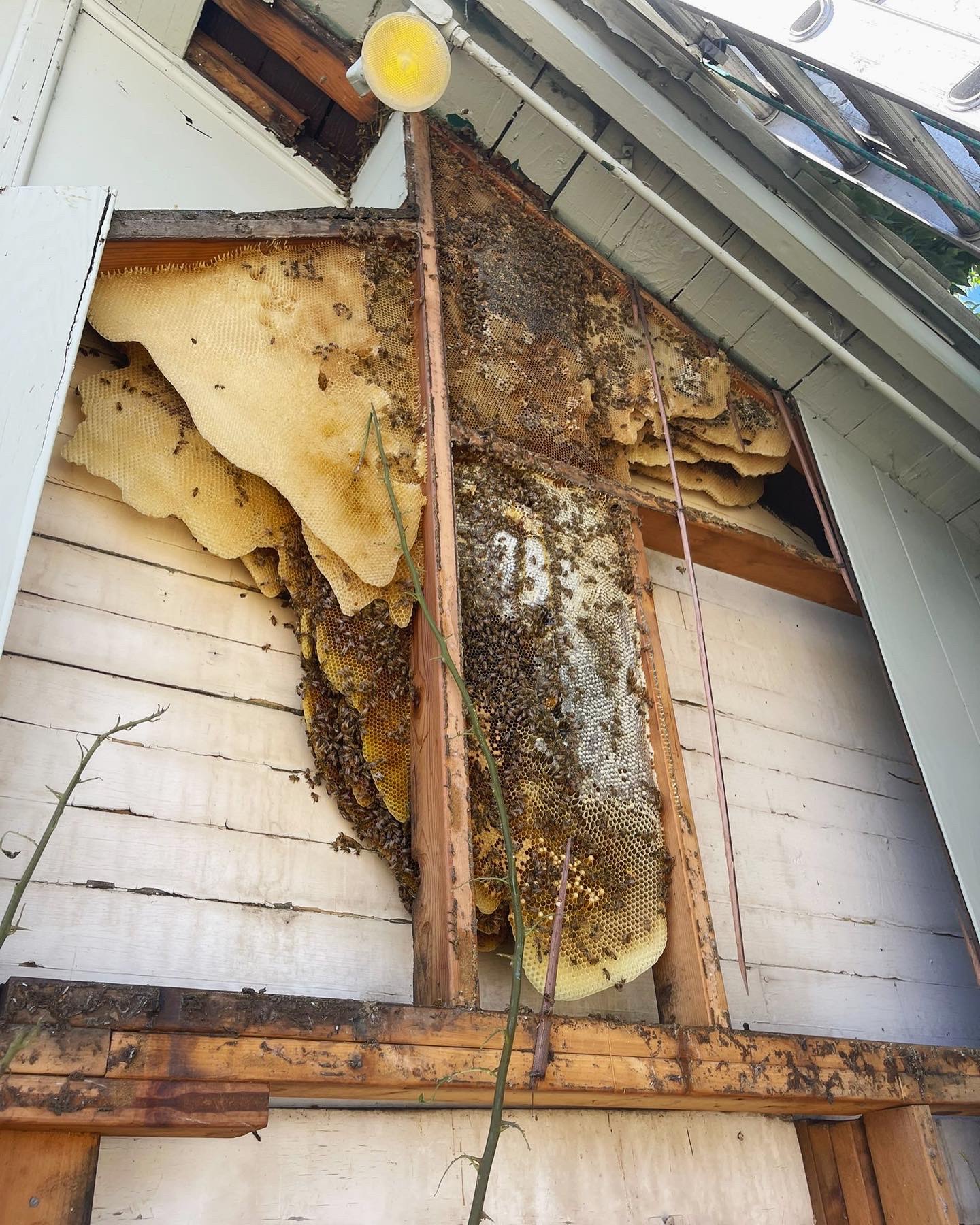
The longer a colony has been established, the more comb and stored honey we may find once the cavity is opened.
A recently established colony may contain relatively little comb. An older colony can contain layers of brood comb, stored honey and wax extending well beyond the entrance.
When we're assessing a job, we ask when the bees were first noticed, whether activity has increased, whether bees have appeared inside the house and whether there has been previous bee activity or treatment in that location.
Those details can tell us considerably more than a photograph of the entrance alone.
A cluster hanging outside is a different situation
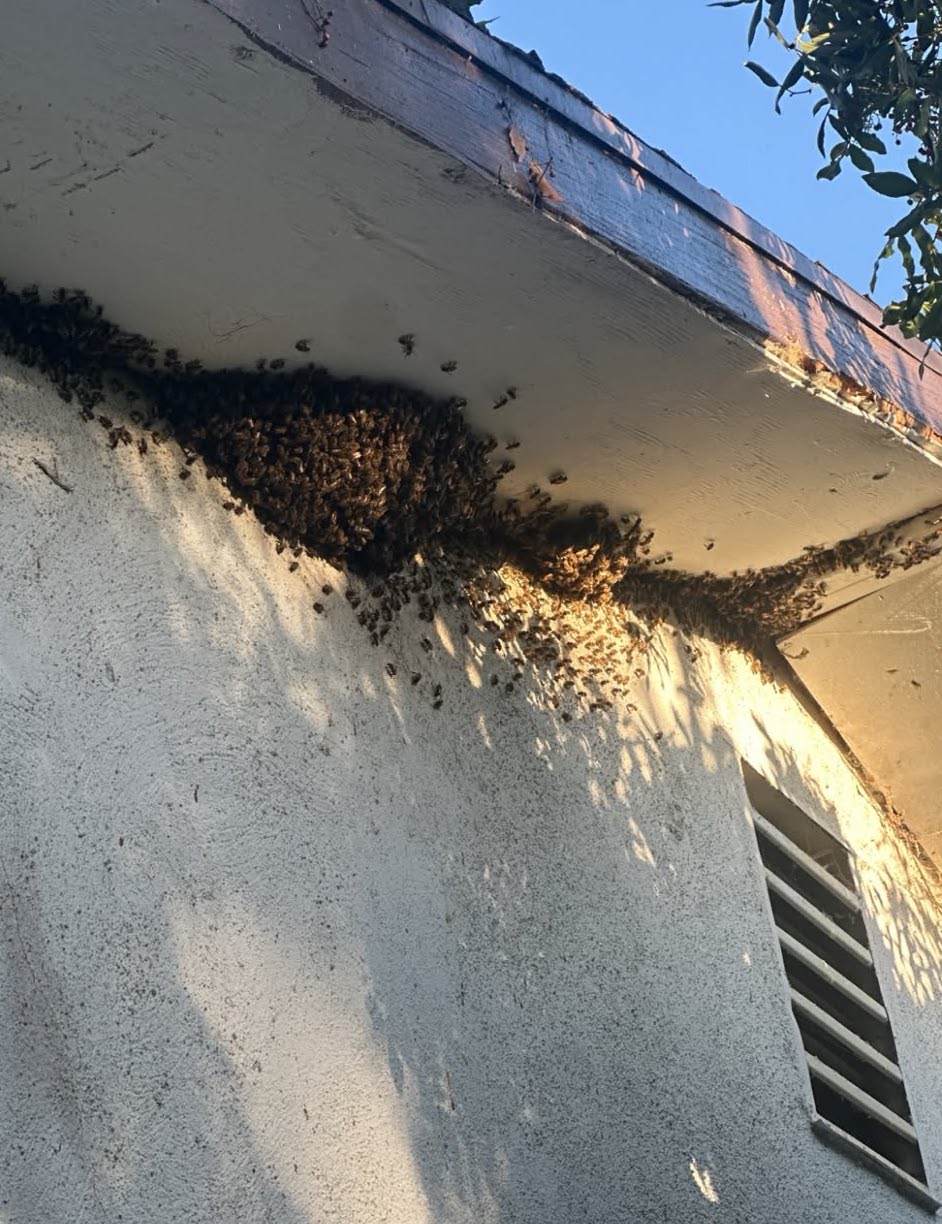
A large ball or cluster of bees hanging from a tree, fence, shrub, roof edge or other exposed surface is generally a swarm rather than an established structural colony.
The bees are temporarily clustered while scouts search for a suitable cavity.
That can last hours or sometimes longer. The problem for a homeowner is that the cavity the scouts choose may be inside the house.
If a swarm disappears from a tree, it doesn't necessarily mean it flew away from the property. Watch nearby rooflines, chimneys and wall openings. We've encountered situations where an exterior cluster disappeared because the bees moved directly into a structural void nearby.
Once they move into a cavity and begin establishing comb, the situation changes from swarm collection to structural bee removal.
Don't seal an entrance while bees are actively using it
If bees are entering a wall or roof, simply filling the opening can make the problem worse.
The colony is still behind the opening.
Bees may search for another exit from the cavity. Depending on the construction, that route can lead through gaps around lights, vents, windows or other openings toward the interior of the house.
Spraying the exterior entrance has a similar limitation. Even if the adult bees are killed, it does not remove the comb, brood, honey and wax inside the structure.
An established colony can leave a significant amount of material behind. Honey can leak when comb is no longer being maintained. Wax can deteriorate in heat. Ants and other pests may find the abandoned material, and residual comb and hive odor can make the cavity attractive to future honey bee colonies.
That's why structural removal is different from treating insects at an exterior opening.
The entrance tells us where to start, not necessarily where the hive ends
If bees are entering through a small hole in stucco, it doesn't mean the colony is sitting immediately behind that hole.
Bees can enter at one point and occupy a larger cavity above, below or beside it.
Before opening a structure, we try to determine the likely location and extent of the colony. That may involve observing flight activity, inspecting corresponding interior or attic areas where accessible, and evaluating how the building is constructed.
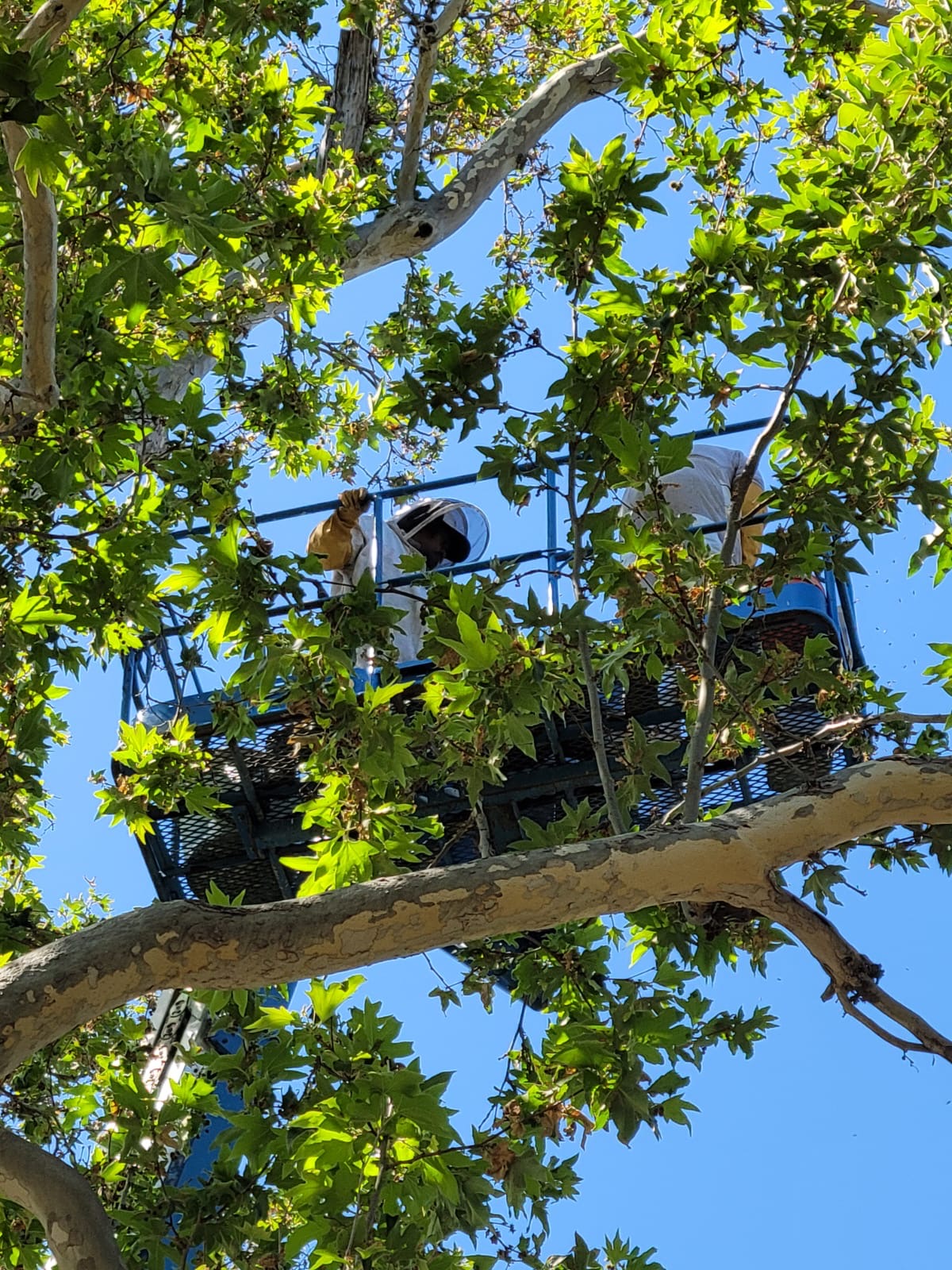
A first-story stucco removal can be straightforward to access. A colony beneath a second-story roofline, inside a chimney or under roofing material may require additional access equipment before we can safely expose the hive.
Once the colony is exposed, the objective is to remove the bees and the hive material rather than simply eliminate the visible activity at the entrance. Depending on the location and construction, the cavity may then need to be cleaned, appropriately treated, sealed, insulated and repaired.
When September bee activity actually needs attention
Bees collecting water from your pool or working flowering plants generally don't require removal.
The activity that deserves closer attention is consistent movement into and out of a structure.
Watch for bees repeatedly entering the same wall or roof opening, bees suddenly appearing inside the house, activity coming from a chimney or vent, or a swarm that has disappeared followed by new traffic at a nearby structural opening.
If you're seeing bees repeatedly entering one part of your Los Angeles home, send us a short video taken from a safe distance. Seeing where the bees enter and how they're flying often gives us enough information to tell whether you're looking at normal foraging activity, a swarm or a colony established inside the structure.