Why Do Honeybees Build Hives Inside Trees?
October 1, 2026 · 5 min read
Why Do Honeybees Build Hives Inside Trees?
"There are bees flying in and out of a hole in my tree. Is there actually a hive inside?"
Yes---if honeybees are repeatedly flying in and out of a hole in a tree, they may have an established colony inside. Honeybees choose hollow trees because the enclosed cavity gives them protection, space to build comb, and a relatively small entrance they can defend.
Across Los Angeles, Pasadena, and the surrounding areas, we regularly find established honeybee colonies living inside hollow sections of mature trees. From the outside, there may be very little to see. The entrance can be a hole only a few inches wide while the cavity inside the trunk or branch contains thousands of bees, multiple sheets of wax comb, brood, and stored honey.
Why Honeybees Choose Hollow Trees
Before houses, chimneys, wall cavities, and rooflines gave honeybees additional places to live, hollow trees were one of their natural nesting sites.
A mature tree can provide exactly what a colony needs: protection from rain and direct sun, enough internal space to build comb, and a small entrance that is relatively easy for the bees to defend.
In Southern California, cavities can develop as trees age, lose limbs, decay internally, or suffer previous damage. A tree can look healthy from the outside while having a substantial hollow area inside.
When a swarm is searching for a new home, scout bees investigate potential nesting locations. If they find a suitable cavity, the swarm may move in and begin establishing a colony.
Is It a Swarm or an Established Colony?
A swarm is usually a temporary cluster of bees gathered on the outside of a tree, branch, fence, or other surface. They may remain there for several hours or a few days while scout bees search for a permanent home.
An established colony is different. The bees are living inside a cavity and have started building wax comb.
If you see bees consistently flying directly into and out of the same hole throughout the day, particularly during warm weather, there is likely a colony inside.
We may also see bees guarding the entrance, bees returning with pollen on their legs, or staining around an opening that has been used for a long time.
You generally cannot determine the size of the colony by looking at the entrance. A small opening can lead to a much larger cavity inside the tree.
What Is Actually Inside the Tree?
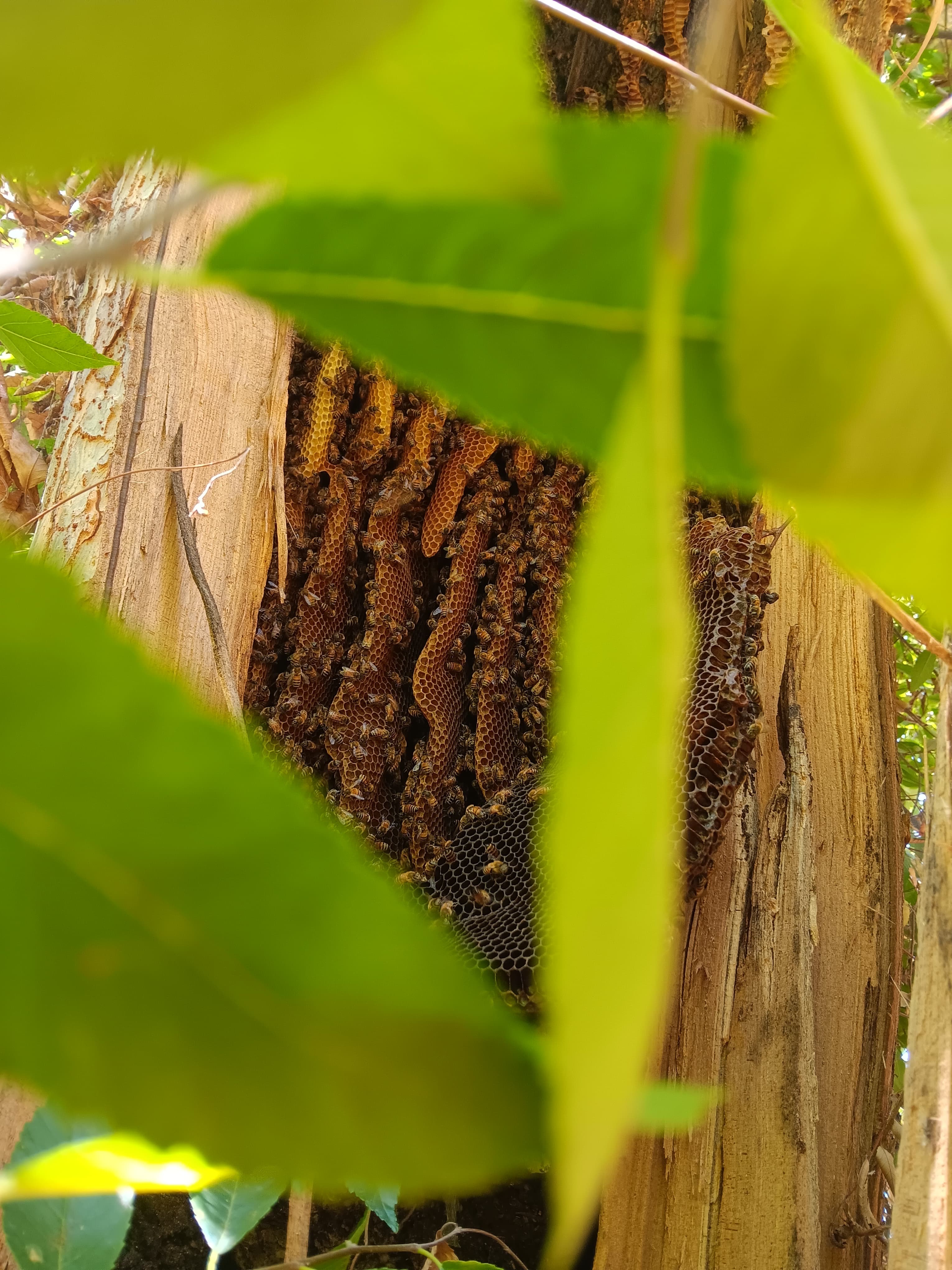 Once we open the cavity, we often find considerably more comb than the
size of the entrance would suggest.
Once we open the cavity, we often find considerably more comb than the
size of the entrance would suggest.
An established colony may contain:
- Live adult honeybees
- A queen
- Brood comb containing developing bees
- Wax honeycomb
- Stored honey and pollen
The comb may extend significantly farther into the tree than the visible entrance suggests.
Simply spraying the entrance or plugging the hole is not a proper solution for an established colony. Sealing an active colony inside can trap thousands of bees, while treating only the entrance can leave wax, brood, honey, and other hive material behind.
How We Remove Honeybees From Inside a Tree
Access is one of the biggest variables with a tree removal. We first determine where the colony is located, where the bees are entering, and how much of the cavity can safely be reached.
If necessary, we may carefully enlarge an existing opening or access another section of the cavity so the bees and comb can be removed.
We collect the live honeybees and place them into a transfer box for relocation. We then remove as much accessible wax comb, honey, and brood comb as possible and clean the cavity.
Removing the hive material is an important part of the job. Old comb, honey, and hive scent left inside a cavity can attract pests and may make the same tree attractive to another swarm later.
After the removal, the accessible cavity may be treated and, depending on the tree and opening, screened, filled, or sealed to reduce the chance of another colony moving into the same space.
What If the Hive Is 20 or 30 Feet Up the Tree?
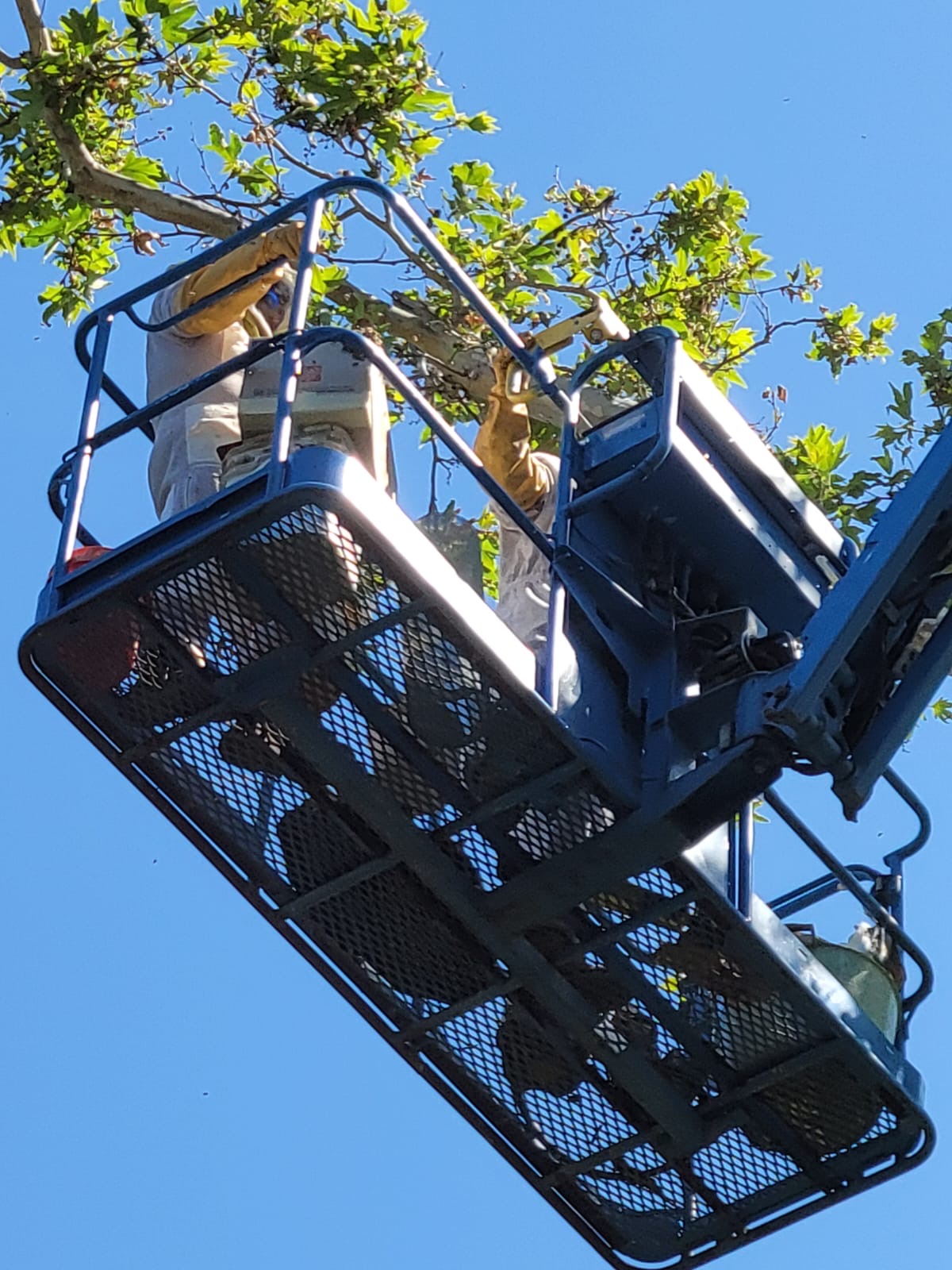 Tree colonies are frequently well above ground level.
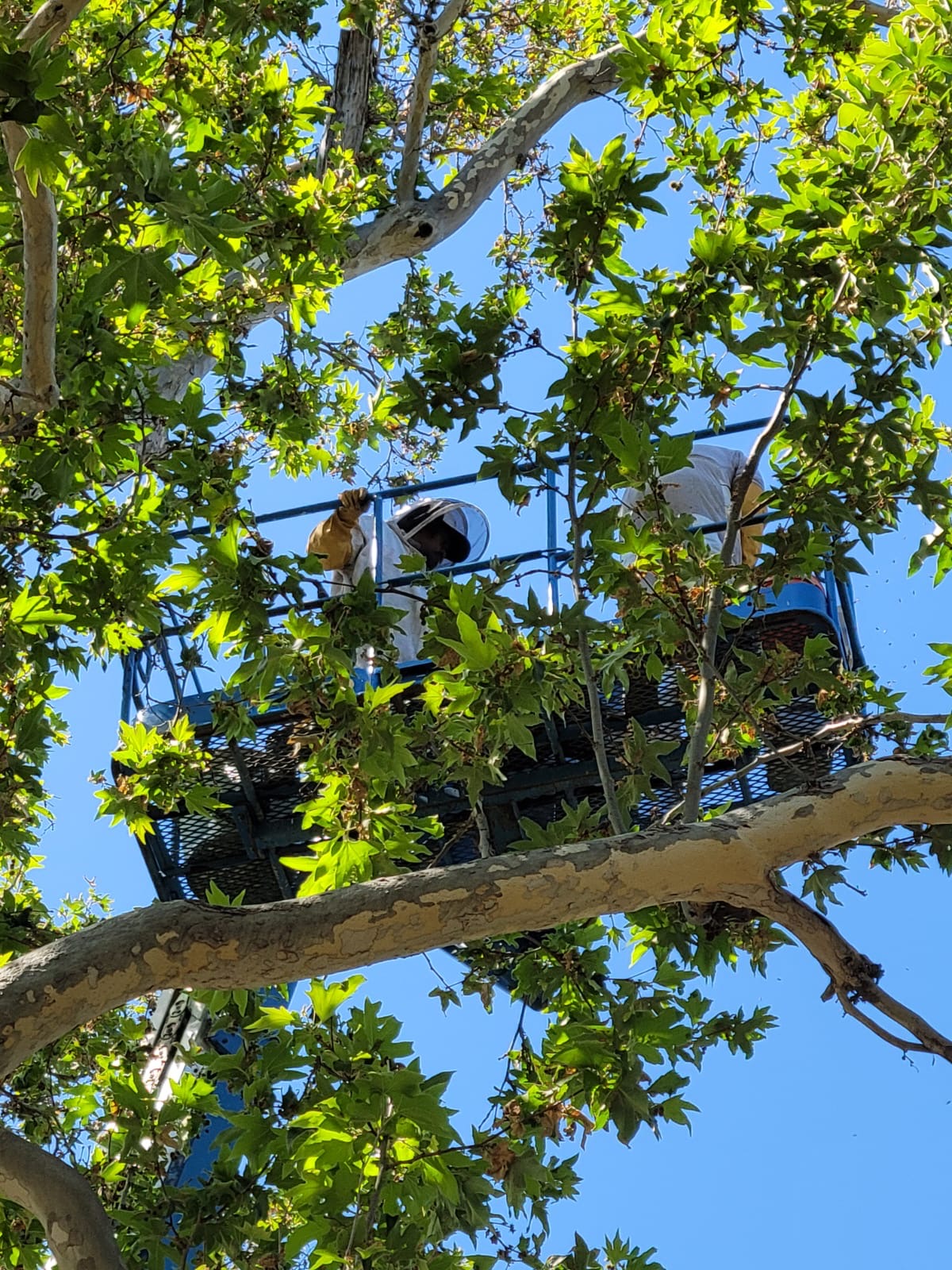
Recent removals we've performed in the Pasadena area have involved colonies approximately 15--20 feet high and others around 30--35 feet high.
Depending on the location, we may use extension ladders, specialized access equipment, or an aerial lift. The correct method depends on more than just the height of the hive.
A colony 30 feet up a tree over an open lawn is a very different access job from a colony 30 feet up above a fence, hillside, pool, roof, or other structure. We look at both the height of the entrance and what is underneath and around the tree before determining how we can safely reach the colony.
When requesting a quote, send us a photo of the entire tree from the ground to the bee entrance, not just a close-up of the hole. We need to see the height, access around the tree, nearby structures, and what equipment may be required.
A close-up photo or short video of the actual bee activity is helpful too.
Does the Tree Have to Be Cut Down?
Usually, no.
Having honeybees inside a tree does not automatically mean the tree needs to be removed.
Our goal is to access the colony while minimizing unnecessary damage to the tree. However, every situation is different. A badly decayed or structurally compromised tree may require evaluation by a qualified tree professional, especially if accessing the colony could affect the tree's stability.
Bee removal and tree safety are two separate issues.
Will Bees Come Back to the Same Tree?
They can.
A tree cavity that housed one colony may remain attractive to future swarms, particularly if old wax, honey, hive scent, or an accessible opening remains.
Whenever practical, we remove accessible comb, clean the cavity, and address the entrance after the colony has been removed.
There may still be some returning forager bees around the original opening for several days after a removal. These are often bees that were away gathering nectar and pollen when the colony was removed.
A handful of returning bees does not necessarily mean the hive has returned. Continued heavy traffic into and out of the cavity, however, should be checked.
If you have honeybees consistently entering and exiting a hole in a tree on your property in Los Angeles, Pasadena, or the surrounding Southern California area, the colony may be considerably larger than what you can see from the ground.
Send Beecasso photos or video showing both the bee entrance and the entire tree, and we can get a better idea of the location, height, and access requirements for a live honeybee removal.
Beecasso Live Bee Removal Inc.
Live honeybee removal and relocation throughout Los Angeles and
surrounding Southern California communities.